2023年四川预赛第8题解答
正文文字 362 字公式 57 处
这道题最近很火,不少粉丝让我写个解答。
视频讲解晚点会上传到我的B站,欢迎大家关注同名B站账号:恩次方根。
视频讲解晚点会上传到我的B站,欢迎大家关注同名B站账号:恩次方根。
题目:(2023年四川预赛第8题)
设A,B,C是△ABC的三个内角,则3cosA+2cos2B+cos3C的取值范围为__________.
展开解答收起解答
答案:
(−(25)/(16),6)
构造:
A→0,B→π,C→0时,原式趋于6;
C→0,cosA→−(3)/(8),cosB→(3)/(8)时,原式趋于−(25)/(16).
证明:
上界证明显然,下面证明:
 公式:3\cos A+2\cos 2B+\cos 3C>-\dfrac{25}{16}
结合A+B+C=π和取等条件,进行均值换元:
设A=(π)/(2)+α,B=(π)/(2)−β,则C=β−α,且由A,B,C∈[0,π],有−(π)/(2)≤α≤β≤(π)/(2).
(注:为方便书写,这里让α,β能够取到端点值.)
于是
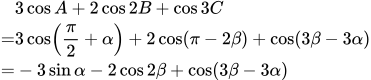 公式:\begin{aligned}
&3\cos A+2\cos 2B+\cos 3C\\
=&3\cos\left(\frac{\pi}{2}+\alpha\right)+2\cos(\pi-2\beta)+\cos(3\beta-3\alpha)\\
=&-3\sin\alpha-2\cos 2\beta+\cos(3\beta-3\alpha)
\end{aligned}
公式:\begin{aligned}
&3\cos A+2\cos 2B+\cos 3C\\
=&3\cos\left(\frac{\pi}{2}+\alpha\right)+2\cos(\pi-2\beta)+\cos(3\beta-3\alpha)\\
=&-3\sin\alpha-2\cos 2\beta+\cos(3\beta-3\alpha)
\end{aligned}固定β,将上式看作关于α的函数\f(α),其中α∈[−(π)/(2),β].
于是f(α)的最小值只可能在端点和极值点处取得.
令 公式:f'(\alpha)=-3\cos\alpha+3\sin(3\alpha-3\beta)=0得:
 公式:\sin(3\alpha-3\beta)=\cos\alpha=\sin(\dfrac{\pi}{2}-\alpha),其中3α−3β∈[−3π,0],(π)/(2)−α∈[0,π].
于是3α−3β=−(3π)/(2)+α或−(3π)/(2)−α.
只需考虑: 公式:\alpha=0,\beta,\dfrac{3\beta}{2}-\dfrac{3\pi}{4},\dfrac{3\beta}{4}-\dfrac{3\pi}{8}的情形.
(1)α−(π)/(2)时,
 公式:f(\alpha)=3-2\cos(2\beta)+\cos(3\beta+\frac{3\pi}{2})\ge 0
(2)α=β时,
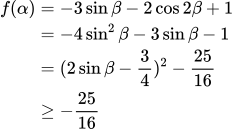 公式:\begin{aligned}
f(\alpha)&=-3\sin\beta-2\cos 2\beta+1\\
&=-4\sin^2\beta-3\sin\beta-1\\
&=(2\sin\beta-\frac{3}{4})^2-\frac{25}{16}\\
&\ge-\frac{25}{16}
\end{aligned}
公式:\begin{aligned}
f(\alpha)&=-3\sin\beta-2\cos 2\beta+1\\
&=-4\sin^2\beta-3\sin\beta-1\\
&=(2\sin\beta-\frac{3}{4})^2-\frac{25}{16}\\
&\ge-\frac{25}{16}
\end{aligned}(3)α=(3β)/(2)−(3π)/(4)时,由α≥−(π)/(2)得:β≥(π)/(6).
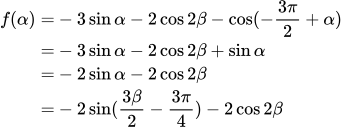 公式:\begin{aligned}
f(\alpha)=&-3\sin\alpha-2\cos 2\beta-\cos(-\frac{3\pi}{2}+\alpha)\\
=&-3\sin\alpha-2\cos 2\beta+\sin\alpha\\
=&-2\sin\alpha-2\cos 2\beta\\
=&-2\sin(\frac{3\beta}{2}-\frac{3\pi}{4})-2\cos 2\beta
\end{aligned}
公式:\begin{aligned}
f(\alpha)=&-3\sin\alpha-2\cos 2\beta-\cos(-\frac{3\pi}{2}+\alpha)\\
=&-3\sin\alpha-2\cos 2\beta+\sin\alpha\\
=&-2\sin\alpha-2\cos 2\beta\\
=&-2\sin(\frac{3\beta}{2}-\frac{3\pi}{4})-2\cos 2\beta
\end{aligned}设β=2θ−(π)/(2)∈[(π)/(6),(π)/(2)],有θ∈[(π)/(3),(π)/(2)].
设t=cosθ∈[0,(1)/(2)],有
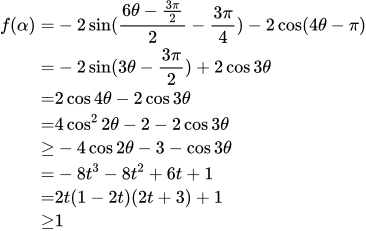 公式:\begin{aligned}
f(\alpha)=&-2\sin(\frac{6\theta-\frac{3\pi}{2}}{2}-\frac{3\pi}{4})-2\cos(4\theta-\pi)\\
=&-2\sin(3\theta-\frac{3\pi}{2})+2\cos 3\theta\\
=&2\cos 4\theta-2\cos 3\theta\\
=&4\cos^2 2\theta-2-2\cos 3\theta\\
\ge&-4\cos 2\theta-3-\cos 3\theta\\
=&-8t^3-8t^2+6t+1\\
=&2t(1-2t)(2t+3)+1\\
\ge&1
\end{aligned}
公式:\begin{aligned}
f(\alpha)=&-2\sin(\frac{6\theta-\frac{3\pi}{2}}{2}-\frac{3\pi}{4})-2\cos(4\theta-\pi)\\
=&-2\sin(3\theta-\frac{3\pi}{2})+2\cos 3\theta\\
=&2\cos 4\theta-2\cos 3\theta\\
=&4\cos^2 2\theta-2-2\cos 3\theta\\
\ge&-4\cos 2\theta-3-\cos 3\theta\\
=&-8t^3-8t^2+6t+1\\
=&2t(1-2t)(2t+3)+1\\
\ge&1
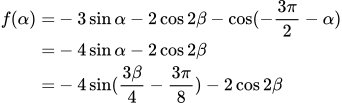
\end{aligned}(4)α=(3β)/(4)−(3π)/(8)时,由α≥−(π)/(2)得:β≥−(π)/(6).
 公式:\begin{aligned}
f(\alpha)=&-3\sin\alpha-2\cos 2\beta-\cos(-\frac{3\pi}{2}-\alpha)\\
=&-4\sin\alpha-2\cos 2\beta\\
=&-4\sin(\frac{3\beta}{4}-\frac{3\pi}{8})-2\cos 2\beta
\end{aligned}
公式:\begin{aligned}
f(\alpha)=&-3\sin\alpha-2\cos 2\beta-\cos(-\frac{3\pi}{2}-\alpha)\\
=&-4\sin\alpha-2\cos 2\beta\\
=&-4\sin(\frac{3\beta}{4}-\frac{3\pi}{8})-2\cos 2\beta
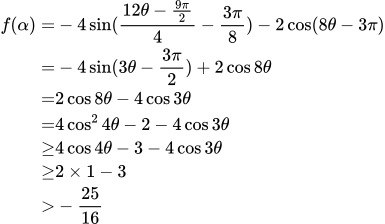
\end{aligned}设β=4θ−(3π)/(2)∈[−(π)/(6),(π)/(2)],有θ∈[(π)/(3),(π)/(2)].于是
 公式:\begin{aligned}
f(\alpha)=&-4\sin(\frac{12\theta-\frac{9\pi}{2}}{4}-\frac{3\pi}{8})-2\cos(8\theta-3\pi)\\
=&-4\sin(3\theta-\frac{3\pi}{2})+2\cos 8\theta\\
=&2\cos 8\theta-4\cos 3\theta\\
=&4\cos^24\theta-2-4\cos 3\theta\\
\ge&4\cos 4\theta-3-4\cos 3\theta\\
\ge&2\times 1-3\\
>&-\dfrac{25}{16}
\end{aligned}
公式:\begin{aligned}
f(\alpha)=&-4\sin(\frac{12\theta-\frac{9\pi}{2}}{4}-\frac{3\pi}{8})-2\cos(8\theta-3\pi)\\
=&-4\sin(3\theta-\frac{3\pi}{2})+2\cos 8\theta\\
=&2\cos 8\theta-4\cos 3\theta\\
=&4\cos^24\theta-2-4\cos 3\theta\\
\ge&4\cos 4\theta-3-4\cos 3\theta\\
\ge&2\times 1-3\\
>&-\dfrac{25}{16}
\end{aligned}倒数第二行的不等式用到了(3)中的结论,两种情况中的θ取值范围是一样的.
综上所述,有f(α)≥−(25)/(16),且等号当且仅当α=β时取得,于是在△ABC中,有
公式:3\cos A+2\cos 2B+\cos 3C>-\dfrac{25}{16}
评注:
本题难度还是很大的,个人认为是整张卷子最难一题(要求证明的话)。其实直接固定变量来求导也是可以做的,但是过程会复杂不少。这里通过均值换元给出了一个稍简洁一些的解答。




留言
正常留言提交后可直接显示,无需人工审核;仍会经过防刷与垃圾内容过滤。请不要留下手机号等私人信息。解法、疑问都可以说;公式用 LaTeX:行内
$…$,整行$$…$$。